

I’ve been reading books in the Business space for quite some time, and the amount of knowledge I’ve acquired over the past few years is immense.
In business, being exposed to the right information/knowledge at the right time can give you a crucial advantage against your competitors or an advantage in your market in general. So I understand the importance of a great book.
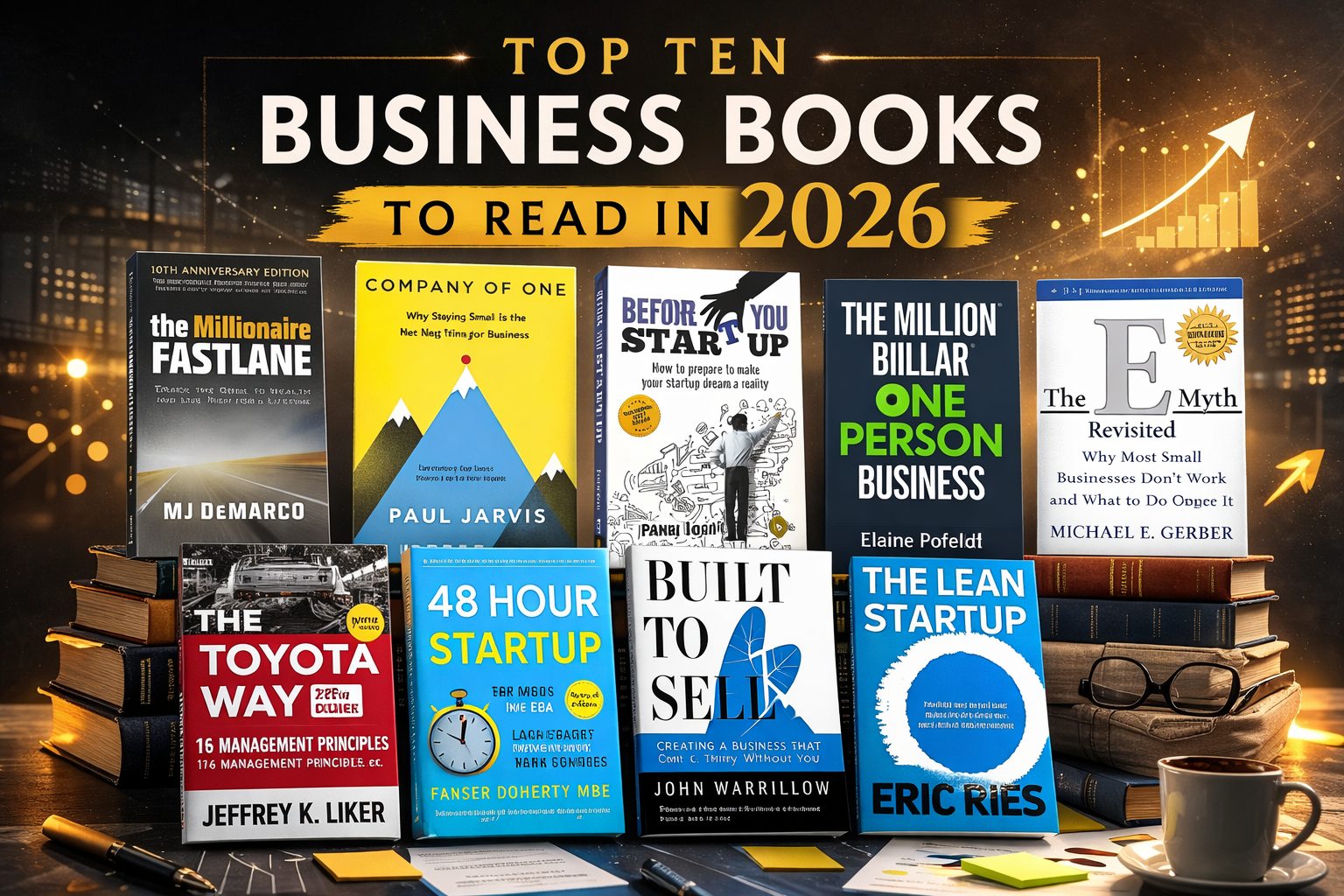
Here I’ve sorted 10 business books that almost all business owners, whether small or big, should read in 2026.
1) The Lean Startup – Eric Ries
The Lean Startup by Eric Ries has to be one of the best books written for early startup founders. I personally can’t emphasize enough how good and IMPORTANT this book is for early founders.
This book will teach you how to build a business under extreme uncertainty by using rapid experimentation instead of long planning. I had to read this book twice when building my first startup because of how important the practical concepts of this book were.
The Core Idea in this book is the Build-Measure_learn feedback loop:- Create a minimum viable product(MVP), then test it with real customers, measure actual behavior(not opinions), and iterate it quickly. Eric Ries emphasizes a lot on validating learning instead of playing a guessing game and falling victim to wishful thinking, and pivoting when the data proves that the assumptions one has made are wrong.
Instead of wasting years on building and perfecting something that nobody wants, build something small or build a prototype, test it in the market with evidence, and once the MVP is validated by real customers, then only improve the existing product and move ahead.
2) Traction – Gabriel Weinberg & Justin Marnes
If you, as a startup founder, really want to grow your Business as quickly as possible, along with building the right product(MVP). Another book that I would highly recommend reading after or with The Lean Startup is Traction by Gabriel & Justin. These two books complement each other like they were written to be read together.
The Lean Startup will teach you how to build the right product as quickly as possible with a tested and validated model, but building the right product does not guarantee growth in business. You will need the right distribution model to validate and grow your business and product.
The author introduces the “Bullseye Framework”,
Which helps you test 19 different traction channels (Like SEO, content marketing, partnerships, paid ads, PR, etc) systematically instead of randomly guessing what will work and what one should do in order to find traction. The author talks about many of the startups failing more from the lack of traction than bad product. It teaches you to treat marketing like a science experiment – first test it small on what works best and ignore vanity metrics.
3) Built to Sell – John Warrillow
This is not particularly for early-stage startup founders but for Business owners who have gained some level of traction, but instead of owning the business and letting it run on its own, they are in a situation where they become the business, not the product/service, and have found themselves stuck in a job instead of running a business.
Through a fictional story, the author shows how service-based founders trap themselves by customizing everything on their own and becoming the bottleneck of the business. So what is the solution?
The solution is to standardize your offering, productize your service, remove yourself from day-to-day operations, and built that makes your business transferable.
The ultimate lesson in this book is to: Build a business, not a job.
4) 48-Hour Startup – Fraser Doherty
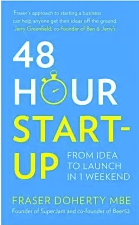
This book agrees that one does not need months of planning to launch their business. You can validate an idea within the weekend and launch your product fully within a few more weeks. The author emphasizes action instead of overthinking.
First of all Identify a simple problem, test demand immediately, build a basic version fast, and get paying customers before refining. The author conveys that there is a psychological lesson in this approach: Confidence comes from execution, not planning. Completing your tasks will motivate you more and boost your confidence, which further helps you in moving forward. This approach reduces friction between idea and implementation.
5) The Toyota Way – Jeffrey K. Liker
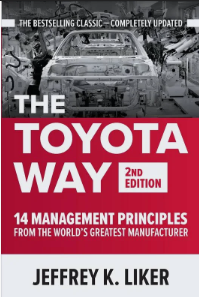
This book is a GOLDMINE for Business owners who are in the manufacturing sector and want to improve their efficiency of production and create a sustainable advantage over time.
This book explains 14 Management principles behind Toyota’s operational excellence and immense success. It focuses on long-term thinking, continuous improvement (Kaizen), respect for people, waste elimination(lean), and building a system instead of relying on hero managers to do or supervise the work.
The philosophies discussed in this book emphasizes on process discipline, quality control, and developing people who can solve problems at the root cause. This book is not just about manufacturing; it’s also about building a culture where excellence becomes a system within the company.
The takeaway: Operational mastery creates sustainable advantage.
6) The E-Myth Revisited – Michael E. Gerber
The book I’m currently reading. This book is for small business owners who have just started their business. This book talks about why most small businesses fail and what to do about it.
This book challenges the myth that being good at a technical skill means you can run a business, which is completely wrong. For example, baking or cooking is a skill, but that’s all you know; running a business requires many other skills to be learned along the way.
Gerber explains three roles inside every entrepreneur: The Technician (who does the work), The Manager (who organizes), and the Entrepreneur (visionary). The majority of small businesses fail because owners stay stuck as technicians. The ultimate solution to this is to build a defined system, so the business works without depending on individual talent, or say business isn’t completely dependent on you. This book pushes you to think like McDonald’s – Replicable, process-driven, and scalable. Work on the business, not in it.
7) The Million-Dollar, One-Person Business – Elaine Pofeldt
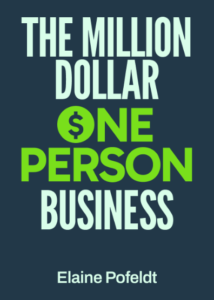
This book becomes extremely relevant and important in today’s economy because with the rise of AI automations, it has become quite easy to run an entire business on your own.
This book studies entrepreneurs who build businesses that generate more than $ 1 million annually without large teams.
This book focuses on leveraging automation, outsourcing work, digital tools (like AI), and scalable models. The idea is that technology allows small teams to operate like large companies, and since AI has seen exponential growth in recent years, there couldn’t be a better time than now to read this book. AI has made it extremely easy to run an entire business on your own and automate most of the tasks through AI. This approach focuses on lean structure, high margins, and intelligent delegation instead of building a huge organization.
8) Before you Startup – Pankaj Goyal
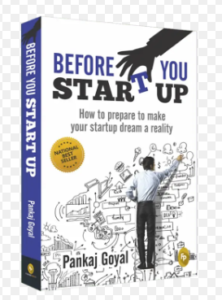
This book was an interesting read for me because the author of this book claims himself to be a failed entrepreneur, which gives readers a different perspective instead of just focusing on success stories, which are far fewer than failure ones, and also he’s from my city, Jaipur, so I had to read it, lol. So this book had me intrigued from the start.
This book provides a grounded and practical look at entrepreneurship before you quit your job and dive deep into entrepreneurship without measuring the Dept. It emphasizes financial readiness, risk assessment, timing, co-founder alignment, and personal clarity. The author encourages readers to look at entrepreneurship from a different perspective, and instead of glorifying startups, it encourages thoughtful preparation.
The theme is strategic patience – making sure your fundamentals are strong before making any irreversible move. This is a must-read for people who are just starting up and are filled with uninformed optimism.
9) Company of One – Paul Jarvis
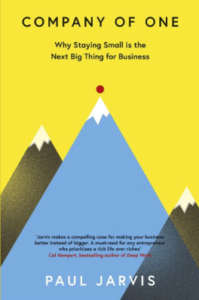
This book challenges the assumption that growth must always mean bigger. Jarvis argues that sometimes staying intentionally small can be more profitable, flexible, and fulfilling than growing into a large entity. Instead of scaling for ego or valuation, one business owner should focus on sustainability, customer relationship and lifestyle design. The goal is resilience, not dominance.
10) The Millionaire Fastlane – MJ DeMarco
This book rejects the slow “save and retire at 65” path and promotes building scalable businesses that create wealth faster. DeMarco describes three financial paths: Sidewalk (poor financial habits), Slowlane (job + long-term investing), and Fastlane (business ownership with leverage). The Fastlane is built on control, scalability, high margins, and large customer reach. The book is aggressive and motivational, pushing you to build systems that generate exponential income instead of trading time for money.
Big Picture (How They Connect)
- Lean Startup + 48-Hour Startup → Validate fast.
- Traction → Get customers.
- E-Myth + Built to Sell + Toyota Way → Systemize and operationalize.
- Million-Dollar One-Person + Company of One → Scale smart, not messy.
- Millionaire Fastlane → Think big about wealth creation.
- Before You Start Up → Stay grounded and strategic.