

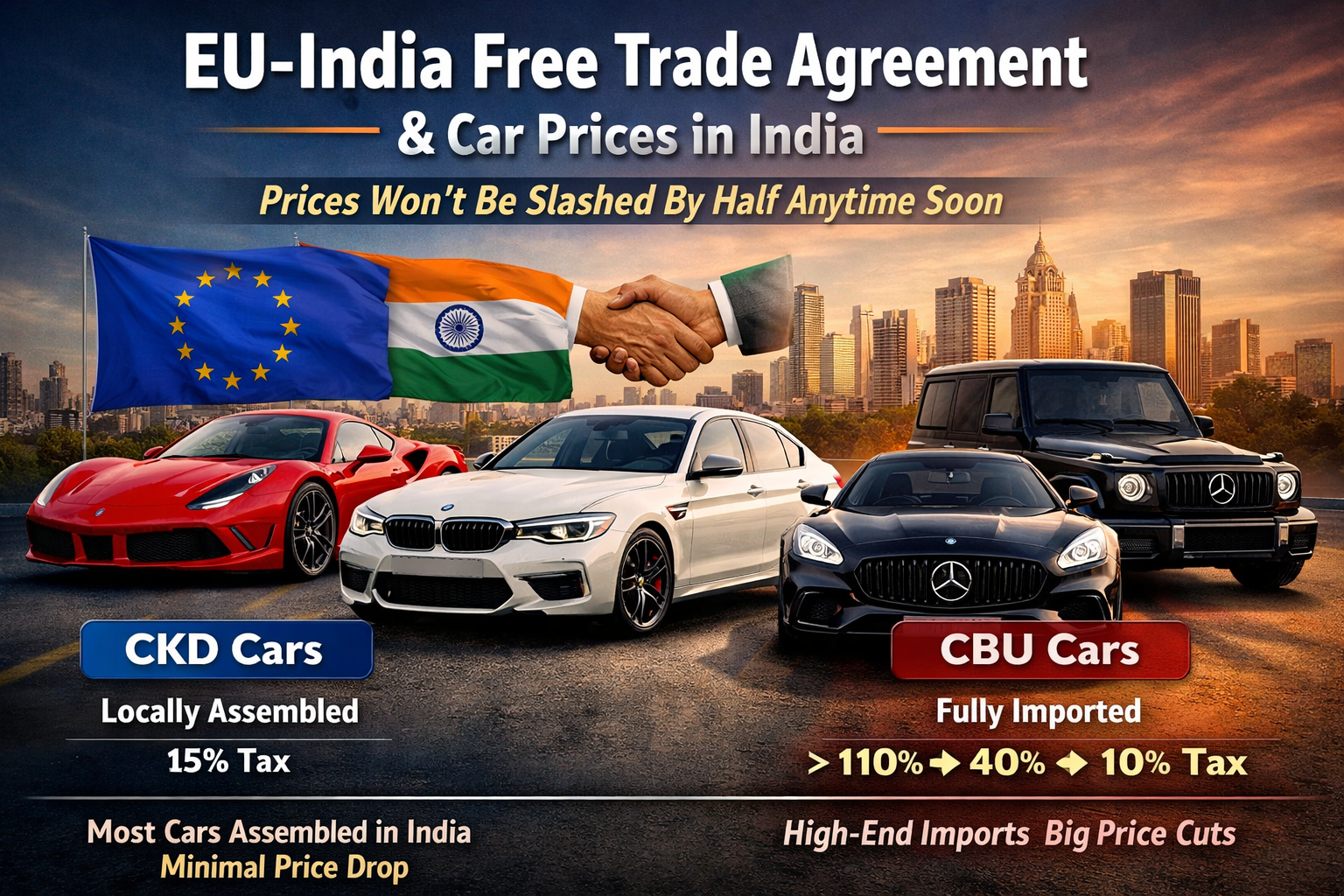
The FTA is practically supposed to reduce car prices by half in the Indian market. But it’s far from reality.
The news that has taken the world by surprise is the new EU-India FTA that has long been negotiated between the two major economies. This is a major step in bilateral trade relations between India and the European Union.
But the topic taking over the headlines is the effect of this FTA on the automobile industry in India. Earlier, European car brands were imposed with a 110% tariff by the Indian government, making European-built cars extremely expensive in the Indian market and making it difficult for European car manufacturers to run their business in India.

Why Most Car Prices in India Are Unlikely to Fall Anytime Soon
On the surface level, it may seem that prices of cars by famous and successful European brands are likely to be cut by half. But that’s still far from reality and, to some extent, misleading — which I’ll explain below.
It is true that under the FTA, import duties on EU-manufactured cars will gradually reduce from the current 110% to 40%, and then year by year it will be reduced to 10% on cars priced above €15,000, subject to an annual quota of 250,000 cars set by the Government of India.
However, the effect of this agreement might take about 18–24 months, as it requires approvals from all the EU member states.
Importantly, Battery Electric Vehicles (BEVs) will not see any duty reduction for at least the next five years.
Now let’s get to the real question — why Indian customers won’t notice a significant reduction in car prices. Even if prices are reduced, they won’t be anywhere close to being cut in half for 90% of the cars.
The reason is simple: about 90% of the luxury cars (around 51,000–52,000 units annually) sold in India are assembled locally from Completely Knocked Down (CKD) kits by brands such as Mercedes-Benz, BMW, Audi, and Land Rover.
CKD kits are taxed at around 15%, compared to 70%–110% for Complete Built Units (CBUs). Since CKD kits are not included in tariff concessions under the FTA, the scope for price reduction for most luxury cars will remain minimal.
Which Cars Will See a Massive Price Reduction?
As mentioned above, only cars imported as Completely Built Units (CBUs) will see a significant price reduction.
More expensive high-end sports and luxury cars, most of which are built entirely in Europe and shipped to India, will benefit the most.
Cars like the BMW M4, BMW M5, Mercedes-AMG models, G-Wagons, and cars from brands like Ferrari and Lamborghini could see noticeable price reductions.
These fully imported CBU models currently attract very high import duties, so any phased tariff reduction under the EU-India Free Trade Agreement could significantly lower their prices in the Indian automobile market.
Conclusion
In conclusion, while the EU-India Free Trade Agreement marks a significant milestone in trade relations, its impact on car prices in India is likely to be gradual and limited. Most luxury cars sold in India are assembled locally through CKD kits, which are not covered under the major tariff reductions. Only fully imported CBUs — mainly high-end sports and exotic cars — are expected to see noticeable price cuts. For the average Indian buyer, dramatic price drops are unlikely anytime soon.